
Conversations at Place RESI 2026 highlighted why partnership will be critical to delivering the homes our region needs.
DevComms North was out in force at Place NW’s Place RESI 2026 last month, which brought together developers, investors, local authorities, housing providers and industry specialists to get into the detail of the challenges facing the resi sector and what we can do about them.
A few themes stood out: viability, affordable housing delivery, the need for innovation and, running through all of them, the importance of stronger partnerships and clearer communication.
Viability remains the challenge
Making schemes stack up financially continues to be one of the biggest barriers to delivery, particularly when it comes to affordable and social housing.
There was a recognition that developers can’t (shouldn’t?) shoulder the full cost of delivering the affordable homes our communities need, and we need to see central government in particular step up and play their part.
Tim Heatley from Capital&Centric raised a fair challenge – if we consider the sector as simply providing a product, why is it the only one that gets blamed for the lack of an affordable version? He also highlighted the potential for councils to retain homes as long-term assets, rather than simply treating delivery as a one-off transaction.
The scale of the challenge is significant. Research published by the Home Builders Federation earlier this year found that the cost of building a new home has risen by around £76,000 since 2020 – more than a fifth of the value of an average new home. With pressures like that, progress often depends on bringing the right partners together, understanding what each can contribute and finding a way forward that works commercially and delivers wider benefits.
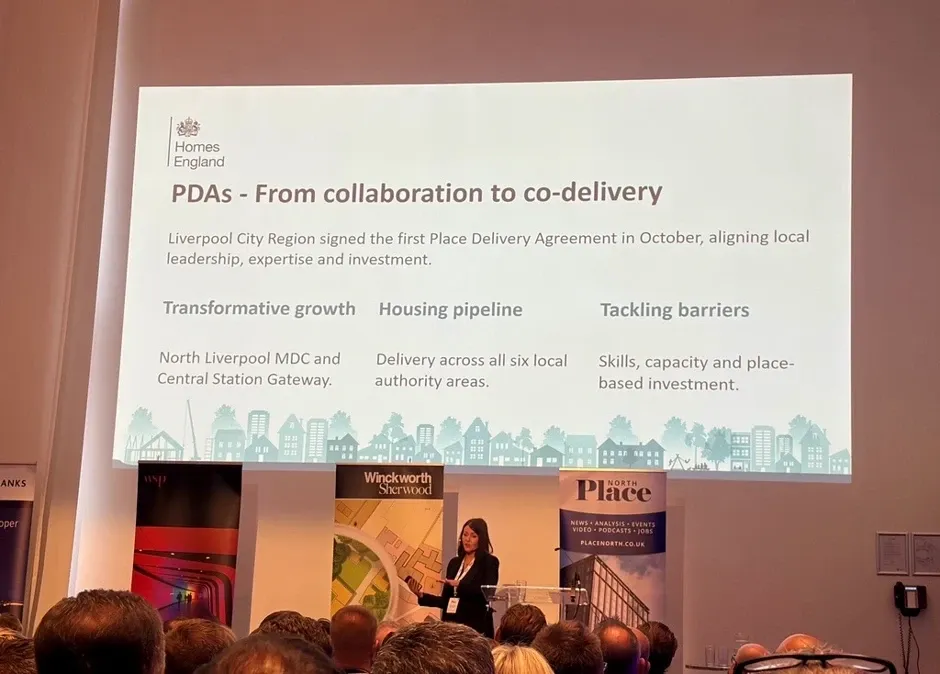
Meanwhile, discussions involving Catherine Holmes of Homes England alongside other industry experts, explored how funding, patient capital and collaboration can help unlock schemes that might otherwise struggle to progress.
Holmes presented the recently announced Place Delivery Agreement (PDA) with Liverpool City Region which aligns local leadership, expertise and investment to shift the needle for key sites from simple collaboration to actual co-delivery.
The PDA is yet to be tested, but it reflects a wider shift in the market: investment in bigger, long-term projects increasingly has to be partnership-led.
But that brings its own challenge: more partners at the table means more priorities and more stakeholders to balance.
Places for the future
The conference looked beyond the immediate pressures of delivery to consider what our communities will need in the years ahead. Rob Chesworth shared The Crown Estate’s long-term perspective on development, reminding us that successful places need to be considered over decades rather than through individual projects.
That long view matters for consultation too. Engagement rightly focuses on how a scheme will affect the people who already live nearby, yet most developments are ultimately built for residents who aren’t there yet – the families, first-time buyers and older people who will call these places home in the years to come.
That opens the door to ideas that move beyond a one-size-fits-all approach that The Crown Estate have been exploring - car barns that take parking away from front doors and free up streets for people, zero-bills homes where solar panels, batteries and heat pumps can wipe out household energy bills, and multi-generational housing that lets families live together while keeping their own space.
Doing something new often takes a leap of faith from developers, investors, local authorities and communities alike, and a willingness to trust one another to be bold. That trust is far easier to build when everyone is involved from the outset, with the fundamental challenges tackled early, before proposals are fixed.
Better communication, earlier engagement
One of the most important takeaways was the need for the sector to tell its story better.
We know that housing delivery faces real challenges, from affordability and infrastructure to the concerns people have about change in their neighbourhoods. But we also need to communicate more effectively why new homes are needed, who they are for and how development can contribute positively to a place.
Early engagement gives people an opportunity to contribute, helps identify issues before they become barriers and allows developers to explain the thinking behind their proposals.
Good consultation is built on open, honest conversations about why things have to happen a certain way: the constraints a scheme is working within, the trade-offs involved and where there is genuine room for local input. Disagreement is a natural and healthy part of that process. What matters is that people understand the reasoning behind decisions, feel their views have been heard and can see the wider benefits of development alongside its impacts.
Planning and development is a highly technical process, and much of its language means little to anyone outside the industry.
As communications specialists, we often act as a technical translator, sitting between that process and the public and turning viability assessments, policy requirements and technical reports into information people can understand, engage with and respond to.
At DevComms, this is where we see communications, stakeholder engagement and political advice making a practical difference.
By helping our clients understand the local landscape, build relationships with decision makers and communities, and articulate a clear and credible case for development, we can help create the conditions for projects to move forward.