
Yesterday, in a ministerial statement somewhat overshadowed by the Chancellor’s budget the day prior, Jim McMahon provided an update on Local Government Reorganisation that you would be forgiven to have missed.
His statement confirmed the government’s decision to withdraw many of the decisions it made earlier this year on LGR following the first phase of its national review, instead pushing forward with just 5 of those initial calls.
Lancashire is one of the counties that has had its decision withdrawn.
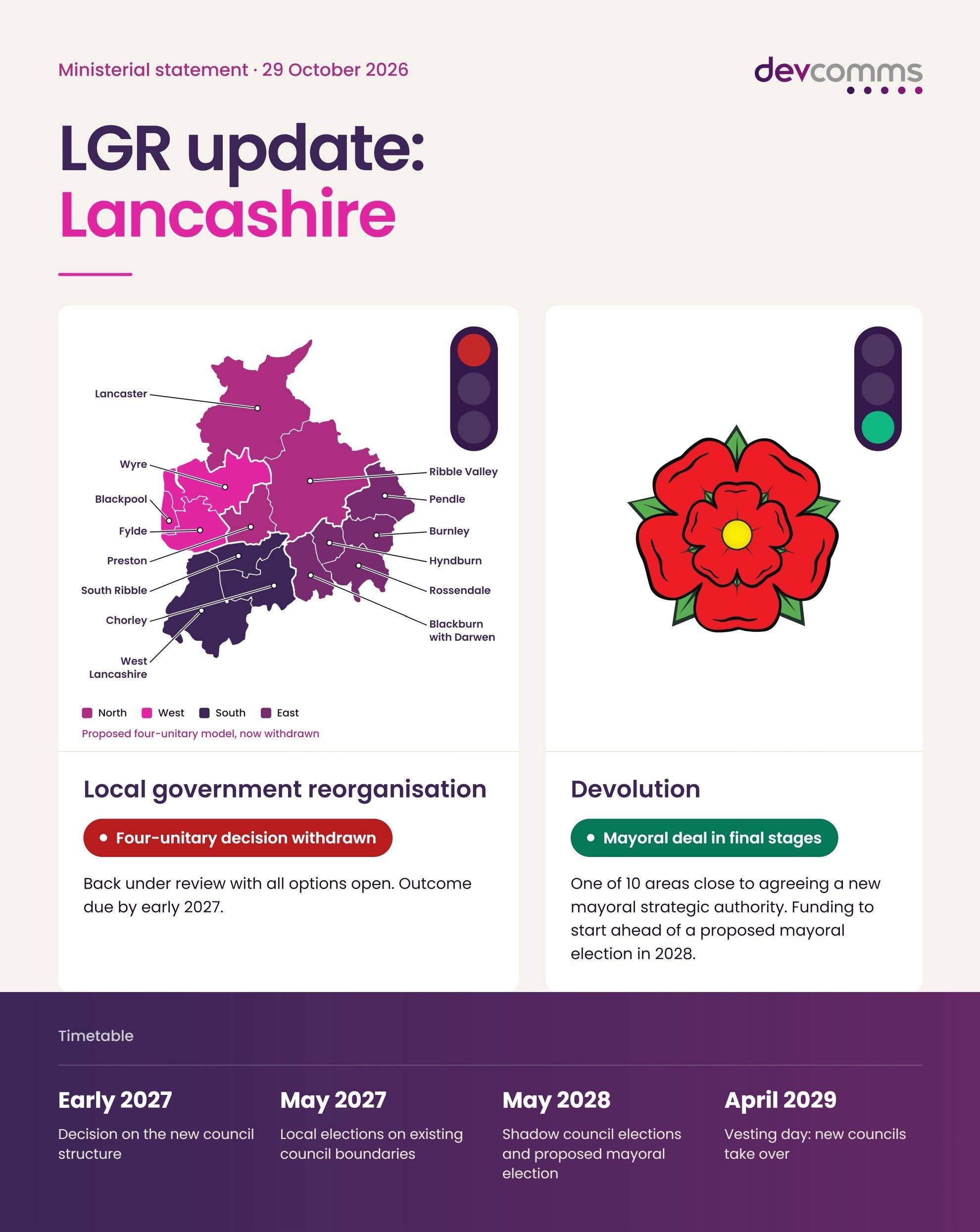
So... what now?
The previously announced four-unitary model may not proceed, but LGR in Lancashire is not cancelled. All options are back on the table and a decision is expected by early 2027. Local elections will go ahead in May next year on existing council boundaries, with the new shadow council elections following in May 2028. The ambition is for the new authorities coming into effect in April 2029, on what is known as “vesting day”.
A new Mayoralty for Lancashire
You’d also be forgiven for tuning out of Healey’s speech by the time he confirmed that 10 areas across England are in the final stages of agreeing a new Mayoral Strategic Authority, of which Lancashire is one. An announcement on the full details of the deal is expected in the coming days. What we do know, however, is that the first mayoral election is expected to be held in 2028, with funding arriving before then.
Typically, Mayors get strategic planning powers that can include oversight of a spatial development strategy, proposed new call-in powers, mayoral development corporations and access to a mayoral Community Infrastructure Levy. In Lancashire, early work on an SDS has already started with the county council. But with the reorganisation timetable moving again, strategic decisions on where growth goes are becoming even more highly politicised.
The mood among local leaders says it all. Cllr Michael Vincent, Conservative Leader of Wyre Council, called the new timetable “absolutely bonkers”. Cllr Caroline Jackson, Green Party Leader of Lancaster City Council, described “this shambles of a process”. And Cllr Matthew Brown, Labour Leader of Preston City Council, warned that “this uncertainty isn’t any good for anyone.”
If the new Mayor takes on these powers, both who makes decisions and where they’re made will change dramatically over the next two years. Any developer with schemes in the pipeline should be talking to local councillors and communities now, not waiting for the new structures to settle.
That is where we, at DevComms North, are here to help!